What is in the vial before you add anything
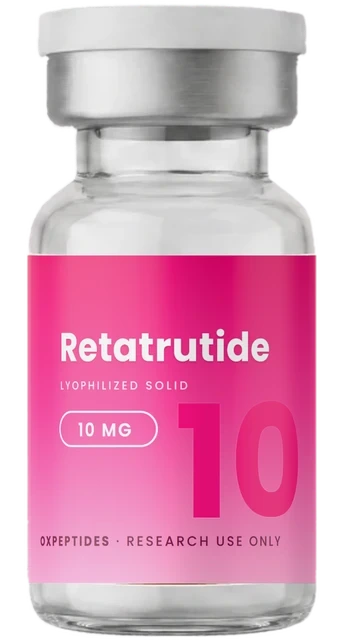
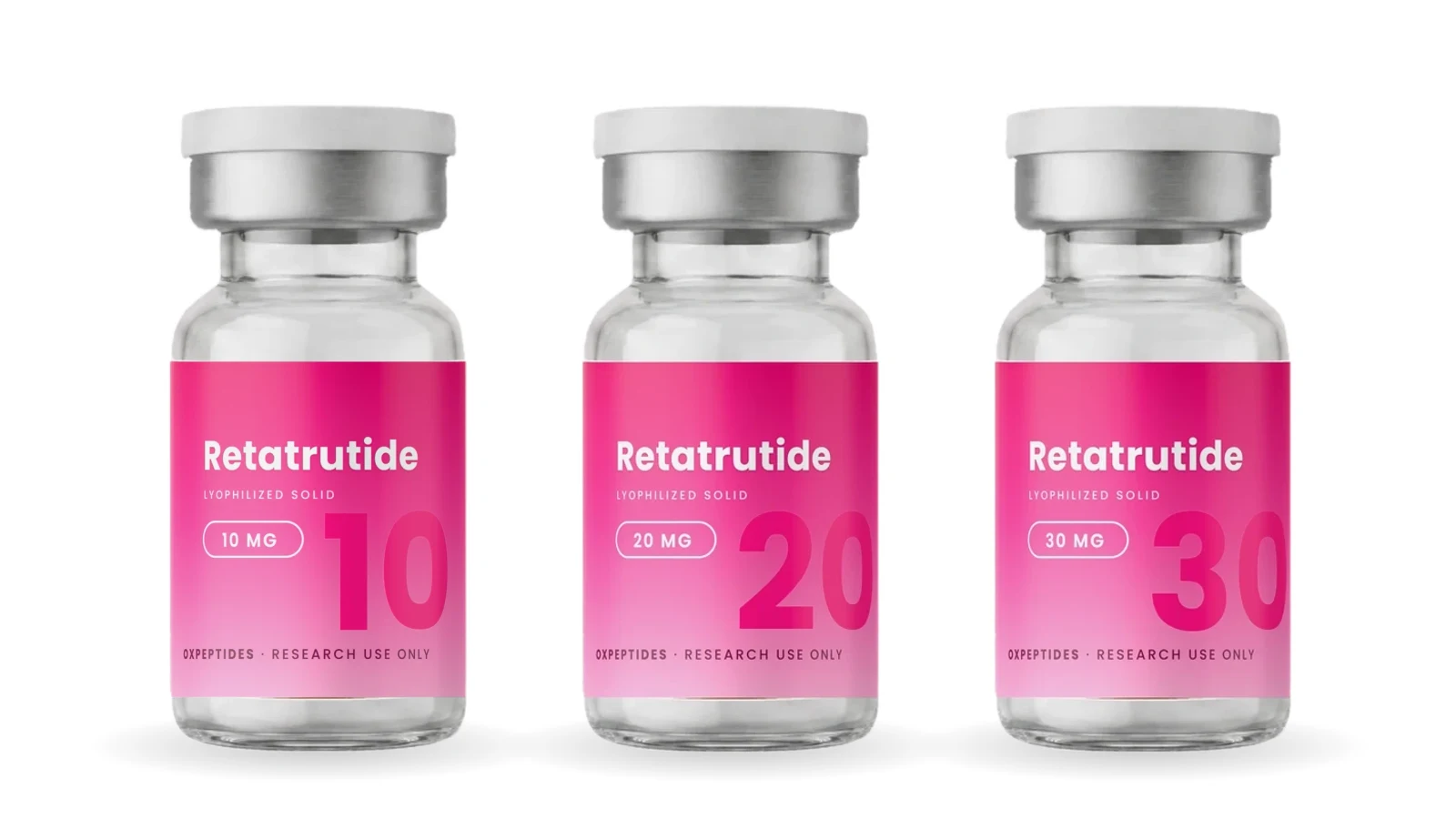
A retatrutide research vial contains a lyophilised (freeze-dried) powder: the peptide, a counter-ion left from purification (usually trifluoroacetate or acetate), residual water, and sometimes a bulking agent such as mannitol. The label states a nominal peptide mass, most often 10 mg, 15 mg or 20 mg. Whether that mass is accurate is the single largest uncertainty in the whole procedure.
In the only published analysis of retatrutide sold outside trials, three vials labelled 10 mg contained 5.13 mg, 16.5 mg and 19.0 mg[1]. Every calculation below assumes the label is right, which is why the certificate of analysis with net content per vial should be read first.
Retatrutide itself is a peptide with a C20 fatty diacid attached through a linker, the same design principle as other once-weekly incretin peptides. The acylation lets it bind albumin and gives it a half-life long enough for weekly dosing in the trials[2]. For handling, the acyl chain means the molecule is amphiphilic: it dissolves in water but forms aggregates if shaken hard, heated or concentrated too far.
The trial doses provide context for what concentrations are typical, not a protocol. The phase 2 obesity trial used maintenance doses of 1, 4, 8 and 12 mg once weekly with starting doses of 2 or 4 mg[3], and the phase 3 type 2 diabetes trial used 4, 9 and 12 mg[4].
Those were delivered from pharmaceutical presentations under medical supervision. This article is about preparing a research solution, and nothing in it is dosing guidance. Retatrutide is not approved for human use.
Key numbers
Which diluent, and how much
Two diluents are common in laboratory work. Bacteriostatic water is sterile water with 0.9 % benzyl alcohol, which suppresses microbial growth in a vial that will be punctured more than once; it is the default for a multi-use research vial.
Sterile water for injection has no preservative and is used when the entire solution will be used in one session. Neither is a buffer, and for cell-culture work the stock is usually diluted further into medium or a buffered saline.
How much to add is a choice about convenience. A 10 mg vial reconstituted with 1 mL gives 10 mg/mL; with 2 mL, 5 mg/mL; with 2.5 mL, 4 mg/mL. The table in the infographic gives the equivalents in micrograms per 0.1 mL, which is the volume that a 1 mL insulin-type syringe marks as 10 units.
Higher concentrations save diluent and vial space but are harder to measure accurately at small volumes; lower concentrations are more forgiving. Write the concentration and the date on the vial the moment you reconstitute; a week later, nobody remembers.
Add the diluent slowly down the inside wall of the vial, not onto the powder cake, and let it sit. Swirl gently or roll the vial between your palms; do not shake. Acylated peptides foam and aggregate when agitated, and aggregated peptide is neither soluble nor active.
A clear, colourless solution is the expected result. Cloudiness, particles or a persistent foam mean either aggregation or a contaminated lot, and the solution should not be used.
Inaccurate dosing alone may represent an important source of risk.
Figure 1
Storage before reconstitution
Lyophilised peptides are stable for months to years if kept cold, dry and dark. The usual research practice is a freezer at -20 °C for long-term storage and a refrigerator at 2 to 8 °C for a vial that will be used within weeks.
The enemies are moisture, heat and light. Moisture is the worst: a lyophilised cake that has absorbed water degrades by hydrolysis and deamidation, and a vial with a compromised stopper should be considered suspect.
Let a cold vial reach room temperature before opening it, so that condensation does not form on the cold powder. Keep it in its box or a light-tight container.
Short excursions during shipping are normal and rarely harmful for a freeze-dried peptide; a week at room temperature in transit is not what degrades a lot. A month in a warm cupboard is.
The lot number, the certificate date and the storage history belong together in a laboratory record. A vial with a certificate dated eighteen months ago that has since been stored at room temperature is no longer described by that certificate. That is the practical meaning of the report date in a COA.
Storage after reconstitution
Once in solution, the peptide is on a clock. Reconstituted retatrutide in bacteriostatic water is stored in the refrigerator at 2 to 8 °C, protected from light, and used within about four weeks as a working assumption; many laboratories aliquot into single-use volumes and freeze at -20 °C to avoid repeated freeze-thaw and repeated stopper punctures. Do not freeze the original vial after reconstitution if you intend to keep drawing from it: each freeze-thaw cycle risks aggregation of the acylated chain.
The degradation products of a peptide in solution are exactly the small peaks that HPLC is validated to detect: oxidation of susceptible residues, deamidation, hydrolysis at labile bonds and aggregation[5].
A solution that has degraded looks the same as one that has not. The only ways to know are a fresh analysis or a conservative time limit. For research work where the concentration matters, the conservative limit wins.
Benzyl alcohol in bacteriostatic water is a preservative against microbial growth, not against chemical degradation, and it is not a sterilant. A vial that has been opened repeatedly with poor technique can still be contaminated.
This is one reason endotoxin on the original certificate matters: it establishes the baseline before the vial is ever opened. When a 2024 study tested GLP-1 peptide vials bought online, every sample contained endotoxin before anyone had reconstituted it[6].
The four errors that account for most problems
- Trusting the label mass. Content varied from 51 % to 190 % of label in tested products[1]. Without a certificate stating net content, every concentration is an estimate.
- Shaking the vial. Acylated peptides aggregate under agitation. Swirl or roll; never shake.
- Losing the concentration. Write mg/mL and the date on the vial. Confusion between a 5 mg/mL and a 10 mg/mL vial is a two-fold error.
- Keeping solution too long. Weeks in the refrigerator, not months. Aliquot and freeze if a lot must last.
Each of these is a documentation problem before it is a chemistry problem, which is the theme of this whole site: the buying guide is about choosing a vendor whose paperwork removes the first error, and the rest is careful bench practice.
The compound remains investigational, not approved by the FDA or the EMA, with phase 3 trials completed in 2026[7]; the research-use distinction applies to everything described here.
Questions readers ask
How much bacteriostatic water do you add to a 10 mg retatrutide vial?
It is a choice of concentration. 1 mL gives 10 mg/mL, 2 mL gives 5 mg/mL, 2.5 mL gives 4 mg/mL. Write the concentration on the vial. This is laboratory preparation, not dosing guidance; retatrutide is not approved for human use.
How long does reconstituted retatrutide last?
Refrigerated at 2 to 8 °C and protected from light, a working assumption of about four weeks is common in research practice. Aliquot and freeze at -20 °C for longer. Degradation is invisible without analysis, so the conservative limit applies.
Can you freeze retatrutide after reconstitution?
Single-use aliquots can be frozen once. Repeated freeze-thaw of the same vial risks aggregation of the acylated peptide. Do not refreeze a vial you keep drawing from.
Why does the solution look cloudy?
Cloudiness or particles indicate aggregation, often from shaking or heat, or a contaminated lot. A clear colourless solution is the expected result. A cloudy solution should not be used.