











Route 1: enrol in a clinical trial
Eli Lilly develops retatrutide under the TRIUMPH program in obesity and the TRANSCEND program in type 2 diabetes. The three TRIUMPH master-protocol trials, with 2 335, 1 152 and 1 946 participants, are listed as completed in April to June 2026[1][2][3], and TRANSCEND-T2D-1 has been published[4].
Further studies, extensions and trials in related conditions such as obstructive sleep apnoea and knee osteoarthritis continue to be registered[5]. A trial is the only route in which the drug is free, GMP-manufactured, given under a protocol and monitored.
The search is simple. Go to ClinicalTrials.gov, search for retatrutide or LY3437943, and filter by recruiting status and location. Each listing gives the eligibility criteria, the sites and a contact.
Lilly also runs its own trial finder. The trade-off is the protocol: a chance of placebo, fixed visits, and no choice of dose. For people who qualify, it remains the most reliable route to the actual drug that exists.
Recruitment is not guaranteed. Completed trials do not enrol, and late-stage programs recruit into specific populations. Someone who does not fit an open protocol will not get in, and no amount of searching changes that. That is the situation the expanded access program was designed for.
Key numbers
Route 2: expanded access through a physician
In June 2026 Lilly registered a pre-approval, single-patient expanded access program for retatrutide, NCT07629401, and it is listed as available[6]. The BMJ reported on it in August 2026 as Lilly opening compassionate use in the United States[7]. The FDA's expanded access rules provide the legal framework[8].
The criteria are strict, and all of them must be met: age 18 or older; refractory obesity, defined as a BMI of 35 kg/m² or more despite adherence to and tolerance of the highest available dose of chronic weight-management therapy; two or more serious or life-threatening obesity-related complications under standard care; inability to take part in an ongoing retatrutide or comparable trial, either because of eligibility or because no site is reasonably accessible; and a shared-decision discussion of all standard options including bariatric surgery. Any medical contraindication to retatrutide excludes.
The request is made by the treating physician through the Lilly Answers Center. Patients and caregivers are directed to their physician rather than to Lilly, and availability depends on geography, supply and an individual eligibility assessment[6].
In practice this route is for a small group of people with severe disease who have exhausted approved options. It is not a route for someone who wants the drug because trial results look good.
Requests are initiated by the treating physician on behalf of the patient; patients and caregivers should be directed to their treating physician rather than contacting Lilly directly.
The routes that do not exist
A prescription. No pharmacy can fill a prescription for an unapproved drug, so no doctor can usefully write one. Compounding. Section 503A limits compounding to approved drugs and listed bulk substances; retatrutide is neither[9], and any clinic advertising compounded retatrutide is advertising something that cannot lawfully exist.
Telehealth. Weight-loss telehealth platforms can prescribe approved GLP-1 medicines; they cannot prescribe retatrutide, and a page on such a platform titled how to get retatrutide is usually a page about how to get something else.
Social media and messaging sellers. This is the grey market described in grey market versus research vendors: no company, no certificate, no label, no recourse. The published record of what arrives from this end of the market is not encouraging.
A 2026 case report described a man with type 1 diabetes admitted with severe vomiting, ketonaemia and acute kidney injury after using an online-purchased product marketed as retatrutide, with no way to establish what it contained[10].
None of these routes are shortcuts to the drug. They are either not retatrutide, not lawful, or not verifiable, and often all three. The legal status article takes each one in turn.
Route 3: research supply for laboratories
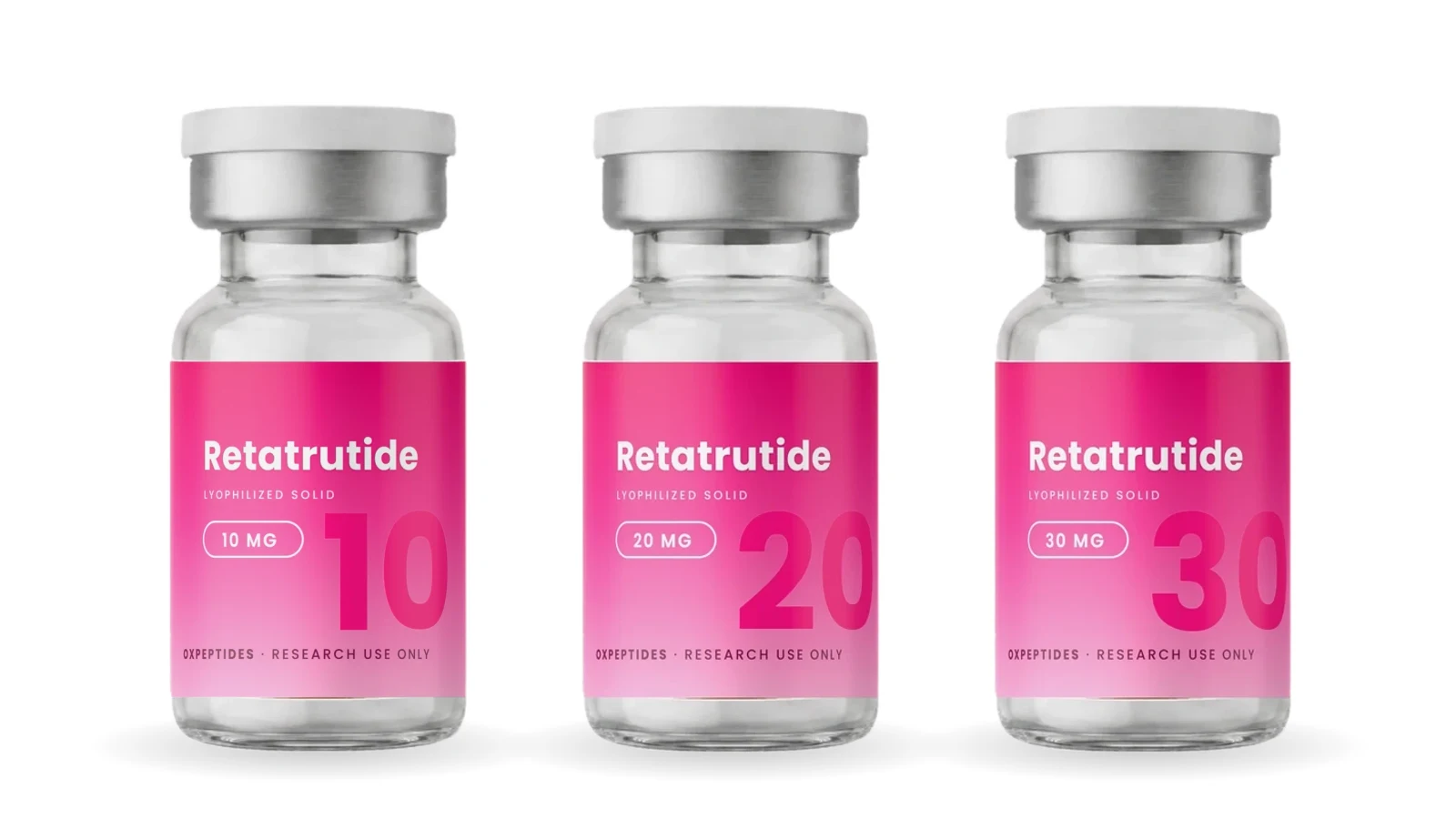
The third route is not for patients. Research vendors sell synthetic retatrutide as a laboratory chemical, labelled research use only and not for human consumption, to laboratories and researchers.
It is lawful as a chemical sale, and it is the only way a laboratory that is not a Lilly trial site can obtain the compound for in vitro or animal work. The research use versus human use article explains what that label commits both sides to.
Because no regulator tests this supply, the quality is whatever the vendor proves. The 2026 Australian analysis of three products sold as retatrutide found genuine material at 5.13 mg, 16.5 mg and 19.0 mg in vials labelled 10 mg[11].
A vendor that publishes a third-party certificate of analysis per batch, with purity, identity, net content and endotoxin, has closed that gap. A vendor that shows a purity number and nothing else has not. The line-by-line check is in how to read a retatrutide COA, and the full vendor checklist is in the buying guide.
OXpeptides (https://oxpeptides.com) is one research vendor we can name that publishes an third-party laboratory certificate per batch and keeps every listing inside the research-use frame. It is listed as an example of what documentation looks like, not as a recommendation to any patient, because no research vendor is a route to treatment.
Figure 2
Which route applies to you
- You have obesity or type 2 diabetes and want treatment. Search ClinicalTrials.gov for an open retatrutide trial. If none fits, ask your physician whether you meet the expanded access criteria: BMI 35 or more, two serious complications, approved therapy already tried.
- You do not meet those criteria. There is no lawful retatrutide for you in 2026. Approved GLP-1 medicines exist and a physician can prescribe them. The approval status article tracks when that might change.
- You run a laboratory. Buy from a research vendor that publishes a per-batch, third-party certificate with net content and endotoxin, and read it before you order.
- Someone is offering it to you in a direct message. That is the grey market. Nothing about that sale can be checked.
The compound remains investigational, not approved by the FDA or the EMA. The phase 2 trial that drives most of the interest reported mean weight change of -24.2 % at 12 mg over 48 weeks in 338 monitored adults on GMP material[12]; nothing about a research vial reproduces those conditions.
Questions readers ask
How do I get retatrutide from my doctor?
A doctor cannot prescribe it, because no pharmacy can dispense an unapproved drug. A doctor can request single-patient expanded access under NCT07629401 if you are 18 or older with a BMI of 35 or more, two serious obesity-related complications, approved therapy already tried and no accessible trial.
How do I qualify for a retatrutide trial?
Each trial on ClinicalTrials.gov lists its own criteria and sites. Search for retatrutide or LY3437943, filter by recruiting status, and contact the site. Completed trials, including the three TRIUMPH obesity trials that ended in 2026, do not enrol.
Can I get retatrutide through telehealth?
No. Telehealth platforms can prescribe approved GLP-1 medicines. Retatrutide is not approved and is not on any compounding list, so no platform can supply it.
Is research retatrutide a way to get the drug?
It is a way for a laboratory to obtain the chemical for research. It is sold as not for human use, has no release testing beyond the vendor's certificate, and is not a treatment route.